

Phonics Reform England: Not reading reform. Phonics reform. Improving phonics for the one in five at risk of struggling to read and spell.
If phonics doesn’t lead to self-teaching, it isn’t working. It should give every child the kick start the brain needs to take over.
For 1 in 5 children, it currently doesn’t. They don’t get to read for pleasure. Let’s change that.

This is not a phonics debate. It is not phonics v not phonics.
Phonics is based on the fundamental principle that reading and spelling involve mapping speech and print in both directions. This means that children can decode man and many, cut and put, chips and Christmas, pant and want. It is how you decode The Chaos. Being able to map words with ease frees up cognitive resources to focus on fluency and comprehension. However, the current system assumes that all children can access and use this in the same way. Around one in four eleven-year-olds in England cannot read at the expected standard.
This is about improving how word napping works for every learner, so they can access books they want to read, work at their own pace, and learn in ways that reflect their pronunciation, including accent differences. It means identifying dyslexia risk early, so that children who need more support with phonemic awareness receive it immediately, preventing the dyslexia paradox, while those who are ready can move ahead. This is why Phonics Reform England asks the difficult questions about explicit instruction, and sets out six connected reforms.

“There comes a point where we need to stop just pulling people out of the river. We need to go upstream and find out why they’re falling in”.
Desmond Tutu
When children discover the joy of reading early, books become something they choose and share with others, rather than something they avoid. That confidence carries into the classroom, helping them learn across all subjects and develop a lifelong love of reading.
Exciting News! One reform down, five to go!


I’d be incredibly grateful if you would share this with any Reception or KS1 teachers in England who teach phonics, or trainee primary teachers who may be willing to help with my doctoral research.
I’m interested in the views and differing experiences of practitioners at different points in their careers. The confidential online interview involves four think-aloud, phonics-related activities using a whiteboard. It’s a way to invite practitioners to open up and speak freely about phonics, the primary strategy for teaching reading in England.
If you are interested in taking part, please email me at e.l.hartnell-baker@pgr.reading.ac.uk
Thank you!
#phonics #research

Teaching Spelling?
Instead of reaching for a one-size/fits-all programme with word lists to work through considered self-paced orthographic learning, so that you’re doing what is expected, word mapping and analysis, but using words the child can’t currently spell or decode when reading?
So, the words each child needs, when they need them, rather than having the whole class work through words that some children may have known for years. Some are bored; some aren’t ready.
You can do this without using a programme. All grades. Personalised learning.
No memorisation of whole words. No taught ‘rules’.
The main investment is you – knowing what is expected when supporting this.
“To spell a word, pupils should identify the phonemes in the spoken word and write the graphemes that represent them.”
The Writing Framework Department for Education, England, 2025, p. 41
Emma Hartnell-Baker MEd SEN
Advocate for Self-Paced Orthographic Learning (SPOL)
SPOL to SPELL! ♡
Structured Linguistic Spelling

.png)
Are teachers in England being supported to map the alphabetic code consistently?
In reading, pupils are taught to decode by identifying graphemes in written words from left to right, saying the corresponding phonemes, and blending those phonemes to say the whole word (Department for Education, England, 2023, p. 47).
In spelling, pupils are taught to say a word clearly, segment it into phonemes, and select graphemes to represent each phoneme in writing (Department for Education, England, Writing Framework, 2025, p. 41).

If you hear someone say words to the effect of ‘She decoded the sentence but didn’t understand it’, we have a teacher-knowledge problem of what is happening.


"Adult distaste for decodable books fails to respect the child's need to exercise a skill. Children want to be self-reliant readers and are delighted when they can apply what they know."
Source: Louisa C. Moats. "Teaching Decoding." American Educator, Vol. 22, No. 1–2, Spring/Summer 1998. American Federation of Teachers, pp. 42–49, 95–96.
These kinds of quotes generate lots of positive reactions from certain people, but they don’t address why teachers are raising concerns in the first place.
They also ignore what reading researchers such as Mark Seidenberg are saying. Are teachers being encouraged to provide as much explicit instruction as each child needs, and no more? Are children being moved from restrictive, GPC-controlled texts to authentic texts as quickly as possible, according to their individual needs? That's what we find many teachers are advocating for. It's not a 'distaste' for decodable readers.
In England, systematic synthetic phonics is mandated, alongside the Year 1 Phonics Screening Check. Schools are doing what Louisa Moats and others have advocated for. Children use decodable readers, three-cueing has been removed from national guidance, and the teaching of whole words and sight words has been replaced with explicit phonics instruction.
Yet, after more than a decade of teaching phonics this way, around one in four children still leave primary school unable to read or spell at the expected standard, and reading for pleasure is at its lowest level for more than 20 years. We know that phonics is needed, to ensure that children can connect speech and print, but what if we now need a closer look at how phonics is being taught, as it is not meeting the needs of all.
Before dismissing those raising concerns, perhaps we should first ask where those concerns come from and why, despite implementing these reforms, outcomes have remained stubbornly unchanged.
That's exactly why Phonics Reform England (PRE) is asking teachers what they think.
Not reading reform. Phonics Reform.
We cannot expect to change practices without understanding teacher beliefs.
➡️ "If children are reading books with words they can’t decode yet, they’ll start guessing instead of reading. That’s when gains disappear."
Do you agree?
What happens when this belief shapes national guidance and classroom practice?
This assumption is embedded within the SSP Validation process (see Note 6), yet it doesn't align with the research.
The SSP Validation guidance can be found here:
SSP Validation supporting documentation, Note 6
Children with strong phonemic awareness can use partial decoding alongside their oral language knowledge and context to identify unfamiliar words, refine their pronunciation through set for variability, and store new word-specific information through self-teaching.
The issue is not whether children encounter words beyond their currently taught GPCs, but whether they have the underlying skills to use those encounters productively.
The evidence from England, after more than a decade of systematic synthetic phonics and tightly controlled decodable texts, suggests that this approach has not ensured successful reading outcomes for all children.
Let’s use these quotes from Seidenberg as a starting point for discussion around Reform 2.

The Reading Framework states:
“Understanding that the letters on the page represent the sounds in spoken words underpins successful word reading. Pupils’ knowledge of the English alphabetic code, how letters or groups of letters represent the sounds of the language, supports their reading and spelling.” (Department for Education, 2023)
Are schools being adequately supported to achieve this?
Where is the evidence?
The Reading Framework states:
“This guidance explains why teachers themselves also need to understand the alphabetic code: evidence supports the key role of phonic knowledge and skills in early reading and spelling.”
(Department for Education, 2023, p.5)
Are teachers being adequately supported to achieve this, especially when words contain untaught GPCs?
Where is the evidence?
At least 1 in 5 children in England struggle with reading long before the Phonics Screening Check in Year 1. By the time difficulties appear in school, confidence may already be falling and reading can start to feel frustrating. The Upstream Team are Level 7 specialists in Specific Learning Difficulties (SpLD), Special Educational Needs (SEN), and Speech, Language and Communication Needs (SLCN). We focus on the underlying speech sound processing and phonemic awareness skills that allow children to more easily connect speech and print, preventing the dyslexia paradox. We are growing increasingly concerned about how phonics has been interpreted by policymakers since the Rose Report, now twenty years old. We know that parents, teachers, and tutors want children to read and spell with ease. Their focus is not simply that children are able to pass the Phonics Screening Check (PSC) at the end of Year 1. It is helping children use phonics as a stepping stone to self-teaching and reading for pleasure. We have launched a movement, a community for those who want every child in the neurodiverse classroom to feel understood as an individual.
👉 “It may be time to stop using the phrase ‘phonics’ and instead talk about bidirectional word mapping.
The phrase ‘phonics’ is often understood as print-to-speech decoding for reading. Bidirectional word mapping makes clear that the DfE expects both directions: print to speech when reading, and speech to print when spelling. In our experience, the second direction is as important as, and often more important than, the first.”
Phonics Reform England
Phonics Reform England is a new initiative focused on improving how children are taught to connect speech and print. Reading is the process of making meaning from written language. For children learning to read in their first language, this depends on their existing knowledge of spoken language. They already understand words, sentences, and meaning through speech. The challenge is to work out how print connects to that system.
In spoken language, words are built from speech sounds. In written language, those sounds are represented by graphemes. Learning to read therefore involves discovering how print maps onto speech so that meaning can be accessed.
Phonics is intended to support this by showing how letters and letter groups connect to speech sounds. However, phonics is only the starting point. It introduces the principle that print represents speech, but it does not, and cannot, teach all of the correspondences children will encounter. English is an opaque orthography, and most words cannot be explicitly taught and will often include untaught correspondences.
Phonics therefore acts as a kick-start. Once learners understand how speech and print connect, they begin to read unfamiliar words by applying this knowledge. Through reading, they start to recognise patterns, refine their understanding, and build a large store of known words. This is the self-teaching process.
This process depends on the ability to identify and work with individual speech sounds. If a child cannot reliably hear and segment the phonemes in a word, they cannot map those sounds to graphemes. Phonemic awareness is therefore a critical foundation for learning phonics. Screening for phonemic awareness through a few days of speech sound play can show whether children have this skill, and how they respond to explicit phonemic instruction before graphemes are introduced.
Those designing phonics instruction for early years classrooms must understand that not all children will progress through the same content at the same pace. However, this is often set aside in the design of whole-class systems that can be managed by a teacher and assessed in a standardised way. This is, primarily, how curricula are organised. For this essential skill, however, we can no longer ignore that children vary in how quickly they develop speech sound processing skills and how readily they move into self-teaching. Some require more time and support to secure these foundations, while others need opportunities to apply their knowledge through reading.
Phonics Reform England focuses on ensuring that phonics works as intended: as a starting point that enables every child to connect speech and print, move into self-teaching, and become a fluent, confident reader. To do this, it is time to focus on individual needs, not administration.
Although, as phonics specialists, we will offer practical suggestions, including strategies to develop orthographic knowledge in ways that centre on what dyslexic children need, this movement is led by a team of dyslexia experts and is grounded in continuously questioning the science. We are action researchers, constantly reflecting on and refining existing knowledge, including our own.
We aim to build a community of thousands of Phonics Reform advisors who can share ideas and work towards supporting the teaching of phonics with greater autonomy. Programmes can support content organisation, for example which GPCs to teach initially, but when scripts and lesson plans have to be followed ‘with fidelity’, we have moved away from teaching.
This movement matters because the pendulum has swung too far. We have moved away from what the science tells us about how children become readers, while also moving away from trusting teachers as professionals and providing them with more training, resources, and greater autonomy.


What does the Department for Education expect?
The DfE expects word mapping to be the strategy used to help children decode and spell (encode) all words throughout the day, across all year groups, that is, applying phonics knowledge. All primary teachers are therefore expected to be able to identify which letters form graphemes and their corresponding sound (phoneme) value in all words.
National guidance defines early word reading and spelling in terms of the relationship between spoken sounds and written letters. This framing applies to all words, including those often described in classroom practice as ‘tricky’ or irregular, where correspondences may be less transparent but still require coordination between phonemes and graphemes.
The Reading Framework states: “Understanding that the letters on the page represent the sounds in spoken words underpins successful word reading. Pupils’ knowledge of the English alphabetic code, how letters or groups of letters represent the sounds of the language, supports their reading and spelling.” (Department for Education, 2023)
The same document further states: “This guidance explains why teachers themselves also need to understand the alphabetic code: evidence supports the key role of phonic knowledge and skills in early reading and spelling.” (Department for Education, 2023)
In reading, pupils are taught to decode by identifying graphemes in written words from left to right, saying the corresponding phonemes, and blending those phonemes to say the whole word (Department for Education, 2023, p. 47).
In spelling, pupils are taught to say a word clearly, segment it into phonemes, and select graphemes to represent each phoneme in writing (Department for Education, Writing Framework, 2025, p. 41). Statutory spelling guidance further states that teachers should draw pupils’ attention to grapheme–phoneme correspondences that both do and do not fit with what has been taught so far (Department for Education, Spelling Framework, p. 75).
The DfE expects teachers to extend programmes and apply phonics to all words, in all year groups, so that children continue to learn correspondences that have not yet been taught. So there is a clear gap between what programmes teach and the code knowledge needed to read and spell words in KS1 and KS2, let alone KS3 and KS4. To learn the whole alphabetic code children need to transition into the self-teaching phase.
Phonics Reform England (PRE) seeks to support teachers to adapt the systematic synthetic phonics programmes they are using to meet the individual needs of children, and in order to do this, we must understand what they know. This matters because too many children are struggling to develop the phonological-orthographic knowledge needed to pass the Phonics Screening Check or to read and spell at minimum expected levels by the age of 11 (Department for Education, 2025a; Department for Education, 2025b).
For a decade, around 1 in 4 children has not met the expected standard in reading and spelling at the end of primary school (DfE, 2024). Although the Phonics Screening Check (PSC) is used as a measure of whether children have reached the expected standard in early decoding, it captures only a narrow aspect of literacy and misses much of what matters for reading and spelling development. Relating to the alphabetic code, the check focuses on blending a limited set of around 95 grapheme–phoneme correspondences, yet English is an opaque orthography with over 300 correspondences in use.
Passing the PSC does not indicate that a child can read with fluency and comprehension or spell with accuracy. More concerning is that around one in five children do not pass even this limited GPC check, and by age 11 around one in four are still not meeting minimum expected standards in reading. This raises a critical question about what is missing in the existing synthetic phoncs programme system between recognising and blending these 100 or so GPCs and reading fluency.
The gap also reflects what is often described as the dyslexia paradox, where the window for early identification and intervention is missed, despite clear indicators being present on school entry. Synthetic phonics programmes alone do not offer sufficient intervention in Reception and Year 1 for the one in five children who can be identified early through screening, and extending more of the same approach beyond Year 1, as recommended by the Department for Education, is unlikely to address their needs, particularly once they are in Key Stage 2. We are unsure whether teachers are being told why these children continue to struggle despite receiving systematic synthetic phonics, or what they need to do differently in response.
The existing focus is largely on learning a defined set of Grapheme to Phoneme Correspondences (GPCs), yet even within this, the phoneme element may vary according to accent, making this approach less secure for some children. When the emphasis remains on producing programme-aligned ‘letter sounds’, rather than understanding how speech connects to print in a flexible and bi-directional way, gaps in word mapping can persist. This means that, alongside showing schools how to strengthen and extend their current provision to prevent the dyslexia paradox in reception and year 1 through earlier identification and support, it is equally important to address the underlying word mapping difficulties experienced by older children in KS2. For these learners, the issue is not simply that they need more exposure to the same GPCs, but that the connections between speech, spelling, and meaning have not been securely established. By making these relationships explicit and responsive to the child’s own spoken language, including accent variation, we can support both early learners and those who have not yet developed independent reading and spelling.
The Upstream Team will show you how, through Phonics Reform England, supporting the transition towards greater inclusion for all learners within the neurodiverse classroom. We focus on bidirectional word mapping at a deeper level that centres on bonding speech sounds (phonemes), spelling (graphemes), and meaning so that words are securely stored in the child’s orthographic lexicon. This also means helping teachers and TAs recognise whether that bonding has actually taken place, rather than assuming success when a child can produce the correct word by blending target grapheme–phoneme correspondences, as in the Phonics Screening Check. Word Mapping Mastery is the goal for all learners, not simply recognising and blending target correspondences and a few high frequency words. It is the secure storage of words in the brain’s word bank that enables self-teaching and, ultimately, orthographic mapping. This is when words are recognised on sight without the need for conscious decoding, and when spelling, the child can judge whether their choices “look right”.
Without this secure bonding, a child may read a sentence such as “The sugar was sweet” accurately, drawing not only on decoding but also partial decoding, set for variability (SfC), and other cues such as images, yet attempt to spell it as thu shoogu woz swet. This reveals that the connections between speech, print, and meaning have not been fully established, and may also indicate confusion between letter sounds and letter names, as seen in swet. We will show you how to analyse writing in a precise and meaningful way, so that errors are not simply noted but understood. Analysis of both reading and spelling must be considered together, followed by the key question, what next for this child. Again, although Word Mapping Mastery® is a trademarked term and intervention support delivered to schools separately, it works, and we are committed to sharing free word mapping guidance and information through Phonics Reform England. It would not be responsible to highlight what is going wrong for at least one in five children learning through synthetic phonics programmes without also offering solutions that we know can both prevent and address these difficulties.
Word Mapping Is Bi-Directional, and Accent Shapes How It Works
English has an opaque orthography, and it is important that we change this, as part of Reform 4. The letter a, for example, has at least 9 sound values, and skilled readers readers use them automatically in context: and, any, also, another, water, was, orange, scary, father.
To show the sound value clearly, we use IPA symbols: ænd, ɛni:, ɔːlsəʊ, ənʌðə, wɔːtə, wɒz, ɒrɪnʤ, skeəri, fɑːðə. We recommend that teachers become familiar with the IPA, as this will help them feel more confident in ensuring that all children be supported. Those training in Word Mapping Mastery receive this training. We agree with Alex Baratta, whose research highlights the pressure on trainee teachers to modify their accents when teaching phonics, reflecting wider issues of linguistic prejudice in education. Rather than expecting teachers to adopt a standardised accent, we argue that tools such as the International Phonetic Alphabet (IPA) could support consistent teaching while allowing teachers to retain their own spoken identity. Dr Alex Baratta is Lecturer in Language, Linguistics and Communications in The University of Manchester's School of Environment, Education and Development. Alex's research within educational linguistics focuses on language and identity, notably accent, and linguistic preference within the teaching profession.
Word mapping is inherently bi-directional, involving both the translation of print to speech and speech to print. In Systematic Synthetic Phonics programmes, children are typically taught to look at graphemes, produce associated sounds, and blend these to arrive at a word. This process reflects grapheme–phoneme correspondence and often results in a single blended form that aligns with a standardised pronunciation, commonly associated with Received Pronunciation. However, it is less clear whether teachers explicitly address what happens next, when the child shifts from this blended form to their own spoken version of the word. If at least one phoneme differs due to accent, the child is effectively modifying the phoneme component of the grapheme–phoneme correspondence, yet this adjustment is rarely made explicit in instruction.
While success is often judged by whether the child can blend and recognise the word in the moment, this does not guarantee that the speech, spelling, and meaning have been securely bonded in the orthographic lexicon. This becomes particularly important when the child’s accent differs from the pronunciation implied by the taught correspondences. For example, when blending <c> /k/, <a> /æ/, <t> /t/, a pupil may produce /kæt/. A child with a New Zealand accent may then pronounce the recognised word as /ket/. If the phoneme structure linked to the spelling is not securely established, the child may later attempt to spell the word by segmenting their spoken form /ket/, leading to spellings such as ket or cet. This illustrates that coordinating phonemes and graphemes is not simply a matter of retrieving taught correspondences, but also of managing variation in spoken forms.
The term word mapping is used here to emphasise this two-way process. While synthetic phonics is often associated with mapping from print to speech, skilled readers also map from speech to print, that is, phoneme–grapheme mapping. This direction becomes especially important when a child’s accent differs from the blended output of taught correspondences. In these cases, children need repeated opportunities to map their own speech to print through encoding, not just decode from print. Although synthetic phonics programmes may acknowledge accent variation in terms of acceptable pronunciation, they do not typically address the implications for how words are stored. It remains unclear whether children are expected to bond the word in their own spoken form or in the programme’s modelled output. Which sounds do they need to store? This is a largely overlooked area in both research and classroom practice.
These challenges are amplified for children with weaker phonemic awareness. They may struggle to blend the sounds, yet still recognise the word and shift to their own pronunciation. If the phoneme structure is not securely established, they may then struggle to hear and segment the sounds in their own speech when attempting to spell. In effect, they are trying to map from their spoken form to graphemes using correspondences that were initially taught through a different phoneme sequence. This creates an additional layer of complexity that is rarely addressed explicitly.
Children who learned to read without formal phonics instruction did not memorise whole words by sight, as was once believed. Instead, they used phonemic awareness to develop orthographic knowledge through exposure to speech and print together. For example, when a parent reads aloud while pointing to words, the child hears the spoken form and sees the written form simultaneously. Over time, they begin to notice which letters correspond to which sounds in specific words, triggering self-teaching. If children do not have sufficient phonemic awareness, they cannot engage in this process effectively. Even with levelled readers that reduce cognitive load through repetition and predictability, they may struggle to progress. Without secure speech–print connections, they can only rely on limited memorisation strategies.
Phonemic awareness is therefore foundational. It underpins both directions of word mapping and enables children to connect their spoken language with written forms, regardless of accent variation. It is why we want to see early risk screening for every three year old!
If children have good phonemic awareness they will instantly bond the speech sounds, spelling and meaning in the brain’s word bank. Use it for spelling lists if used. Dyslexic? Print off the mapped word or words and do the The Spelling Routine to support word mapping mastery of all words, including KS2 Statutory Spelling Words. That sequence stores the word in the orthographic lexicon and addresses underlying phonemic awareness challenges.
Dr Alex Baratta from The University of Manchester found that trainee teachers, particularly those from the North and Midlands, often face pressure to “standardise” their regional accents, with some being told to adopt Southern pronunciations when teaching phonics. Around 25 percent of teachers surveyed reported being asked to modify their accents, with some even told they should “go back to where you come from” if they could not. This pressure is frequently justified through what can be described as the phonics argument, where mentors demand accent modification to ensure consistency, often positioning Received Pronunciation as the preferred model and framing it as making teachers “better role models”. Baratta argues that this reflects a form of linguistic prejudice, where regional accents are wrongly associated with being unclear or less authoritative. The impact on teachers can be significant, with some describing a sense of identity loss as they feel required to change how they speak in order to succeed professionally. Mentors may impose their own, often unspoken, expectations, suggesting, for example, that northern teachers should adapt their pronunciation of words such as “bath” or “bus”. Research indicates that most pupils do not experience regional accents as a barrier to understanding. However, the focus of Phonics Reform England is on the learners who do struggle, including those who are not reading at minimum expected levels by age 11 or spelling with accuracy.
Baratta’s work suggests that teacher training should prioritise clear communication rather than eliminating regional linguistic identity. However, we have identified a practical way to bridge these discrepancies through bi-directional word mapping. We draw on a universal reference system, the International Phonetic Alphabet (IPA), also described in this way by Stanislas Dehaene in Reading in the Brain (p. 32), and use it alongside explicit discussion of how the phoneme component can shift depending on accent. In some cases, the grapheme boundaries may also shift. For example, with a word such as car, when children map the sounds /k a r/, those at risk begin to understand how their spoken form relates to the written form. They recognise that, in their accent, the <a> may represent a sound that corresponds to <ar> for other speakers, meaning the grapheme representation can vary. By making this explicit, children are able to bond the speech sounds, spelling, and meaning in their mental lexicon. Importantly, they still spell the word as car, or segment it as <c> <ar> when appropriate, rather than producing incorrect forms, because they understand the underlying correspondences and how they apply across accents.
Try the word mapping mastery tech with words your child or pupil needs phonemic awareness support and can’t decode or spell without help. It will also help adults understand English orthography and the language of orthographic mapping. The grapheme markers can be changed locally, using the Orthographic Mapping Tool (a lite version shown here and the phonemes changed with the use of Phonemies, using MyWordz® MyWordz® Technology is being considered for the DfE EdTech Testbed Pilot
One trainee teacher from Leicester who described her accent as “Midlands”, was told that if she wanted to teach phonics – which is used in primary schools to teach reading and writing – it would be best “to go back to where she came from”. If she didn’t, she was advised to use a teaching assistant to teach children certain sounds that differed from her own accent.
“I was quite affronted by the comment to ‘go back to where I came from’, as it was made in front of the whole seminar group, and I felt it was a little unnecessary,” she told researchers.
Baratta said
“We live in a society in which equality is championed and diversity is celebrated, certainly within the workplace, so why does it feel as if the teaching profession is completely discarding the unique richness that comes with regional accents?”

Although the Department for Education has begun to acknowledge that regional variations in pronunciation are acceptable when children blend grapheme–phoneme correspondences, the guidance does not clearly explain how teachers should manage this in practice. As a result, many programmes continue to model blending in ways that align with Received Pronunciation, creating an implicit standard that teachers may feel pressured to follow, as highlighted in the experiences described in Alex Baratta’s research. The Upsteam Team do not see variation as something to accommodate or overlook. We actively embrace linguistic diversity as a strength. Regional accents are not a barrier to learning, they are part of how children make sense of language. The issue lies in the absence of a shared framework to help teachers work with these differences confidently and explicitly. Without this, teachers are left to navigate complex decisions about how speech connects to print, increasing the risk that phoneme–grapheme mapping is not securely established. When variation is recognised, explored, and made visible, it strengthens understanding and supports accurate word mapping for all learners.
Reading for Pleasure at a 20-Year Low: Levelled Readers Didn’t Need to Go
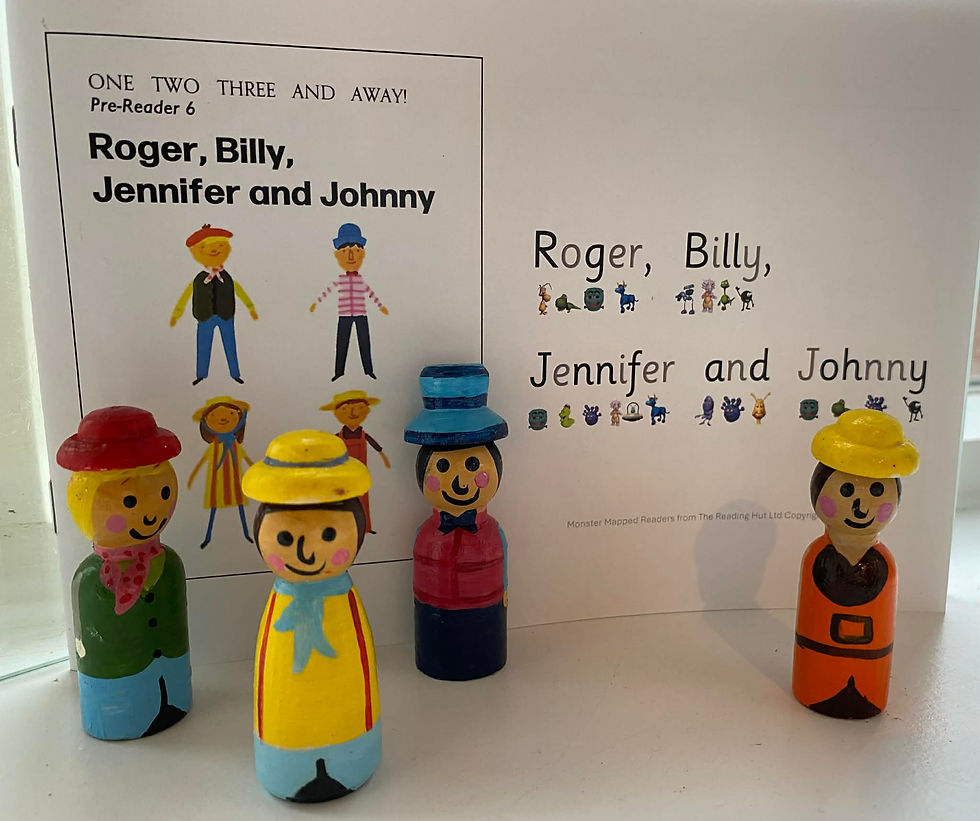
As stated above, we do not recommend The Village with Three Corners simply because it offers opportunities to encounter "sight words". It was selected to facilitate rich, animated talk about the stories and characters, enabling children to engage deeply with language through discussion, retelling, and interaction.
Most children acquire much of their native language with relative ease through exposure to an engaging, active speech community in their early years. However, some children come from linguistically impoverished environments, with limited pre-school exposure to the kinds of verbal interactions and language play that support the development of more advanced language skills. This includes the ability to understand and use the kind of language used in school for learning, explaining ideas, and talking about topics beyond everyday conversation. For these children, access to rich language environments is essential, alongside explicit classroom support to develop their language.
Parents can ask libraries to stock these books, so they do not need to buy them. For £10 per month, schools can access all books online through SpeedieReadies.com. The first 52 are orthographically mapped, so children can see which letters are graphemes and their sound value.
Reading for pleasure in England is now at its lowest level in two decades, with fewer children choosing to read in their free time than at any point since records began (National Literacy Trust, 2023). This decline reflects more than changing habits, it signals a deeper issue in how children experience reading in the early stages. When reading remains effortful, limited, or disconnected from meaningful text, children are less likely to see it as something they want to do. The purpose of Phonics Reform England is to address the root of this by ensuring that early instruction works for all children. When phoneme–grapheme mapping is secured early, reading becomes easier, more fluent, and more enjoyable, and the choice to read changes. At the same time, within Reform 6, we show how levelled readers can be made decodable so that children can access scaffolded texts that offer repetition and predictabiity, while also being able to crecognise and spell hundreds more high-frequency words earlier, giving them access to a wider range of texts and increasing the likelihood that they will choose books they genuinely want to read.



The DfE Recommended the Removal of Letters and Sounds Phase 1
Phase 1 of Letters and Sounds (Department for Education, 2007) focused on developing children’s awareness of speech sounds without introducing print. It included activities such as environmental sound discrimination, rhythm and rhyme, alliteration, voice sounds, oral blending, and oral segmenting. The aim was to build phonemic awareness so that children could hear and manipulate sounds before linking them to graphemes. However, during the recent SSP validation process, the Department for Education offered new guidance to Systematic Synthetic Phonics programme developers who have based their programmes on Letters and Sounds (eg teaching GPCs in the order s a t p i n m d ...) to begin with grapheme–phoneme correspondences from the outset, effectively moving away from Phase 1 as a distinct pre-phonics stage. In practice, this reduces opportunities for children to develop secure phonemic awareness prior to working with print and it concerns us.
Schools across England are now addressing this gap by using the 10 Day Speech Sound Play plan we recommend as a pre-phonics approach. This introduces isolating, segmenting, and blending speech sounds alongside early graphemes such as s, a, t, p, i, n, by day 5, moving from speech to print. Crucially, this provides an opportunity to screen for dyslexia risk on school entry, before reading difficulties emerge, aligning with the focus of Reform 1.
Although the Reception Baseline Screener (RBS) is intended to provide an early indication of children’s starting points, including aspects of phonemic awareness, it is a brief, stand-alone check that offers limited insight for teachers and is not well suited to the realities of the Reception classroom. In practice, it adds to teacher workload without yielding meaningful, actionable information about how children process speech sounds or how best to support them. Screening should not sit outside of learning as a separate task. It can, and should, be embedded within everyday classroom practice. The same applies to the Phonics Screening Check. Rather than functioning as a high-stakes assessment at the end of Year 1, the focus could shift towards teachers continuously observing and evaluating whether children can recognise grapheme–phoneme correspondences and blend them successfully over time.
This would allow schools to show how far each child has travelled. Some children may arrive already able to recognise and blend grapheme–phoneme correspondences, while others may take 12 to 18 months to reach this point. A single pass rate, such as the current national average of around 80 percent, does not capture this variation. It can mask important differences in intake, including the proportion of children with higher risk factors on entry, and may even obscure slower progress in some contexts. More importantly, it does not address the critical question of why around 20 percent of children are still not meeting expectations after two years of instruction. We have seen that outcomes can be different, with over 90 percent of children reaching this point by the end of Reception in some settings, which suggests that earlier, more responsive approaches are possible.
Although the Reception Baseline Screener is positioned as a tool to check early phonemic awareness, schools are not being supported to use or adapt a comprehensive phonemic awareness plan that ensures speech–sound foundations are securely in place before introducing grapheme–phoneme correspondences. When this foundational work is embedded within daily learning, rather than treated as a separate assessment event, it becomes both more efficient for teachers and more meaningful for children.
Phonemic awareness on school entry is widely recognised as a critical foundation for later reading and spelling development, with substantial evidence showing that children’s ability to identify, segment, and manipulate speech sounds predicts literacy outcomes (Ehri, 2005; Hulme & Snowling, 2014; National Reading Panel, 2000). During a Phase 1 stage, or through approaches such as Speech Sound Play, children have the opportunity to attend to and work with the sounds of words in their own spoken language before graphemes are introduced. This aligns with research emphasising that phonological representations are shaped by a child’s linguistic environment and accent (Treiman, 1993; Ziegler & Goswami, 2005). By focusing first on listening, segmenting, and blending speech sounds, children develop an awareness of the phoneme structure of words as they use them, which supports later mapping to print. When this early work is grounded in the child’s own pronunciation, rather than an imposed model, it strengthens the connection between speech and spelling, enabling more effective orthographic learning once grapheme–phoneme correspondences are introduced.


References
Ehri, L. C., Nunes, S. R., Willows, D. M., Schuster, B. V., Yaghoub‐Zadeh, Z., & Shanahan, T. (2001). Phonemic awareness instruction helps children learn to read: Evidence from the National Reading Panel’s meta-analysis. Reading Research Quarterly, 36(3), 250–287. https://doi.org/10.1598/RRQ.36.3.2
National Reading Panel. (2000). Teaching children to read: An evidence-based assessment of the scientific research literature on reading and its implications for reading instruction. National Institute of Child Health and Human Development.
Hulme, C., & Snowling, M. J. (2014). The interface between spoken and written language: Developmental disorders. Philosophical Transactions of the Royal Society B: Biological Sciences, 369(1634), 20120395.
Treiman, R. (1993). Beginning to spell: A study of first-grade children. Oxford University Press.
Ziegler, J. C., & Goswami, U. (2005). Reading acquisition, developmental dyslexia, and skilled reading across languages: A psycholinguistic grain size theory. Psychological Bulletin, 131(1), 3–29.
Rising Phonics Screening Check Scores, Stagnant Literacy Outcomes
Over the past decade, around one in four children in England have continued to fall short of minimum expected standards in reading and spelling by the end of primary school, raising serious questions about the effectiveness of current instructional approaches. While the Phonics Screening Check (PSC) has shown rising pass rates since its introduction, these gains have not translated into sustained improvements in broader literacy outcomes. National data indicate that a significant proportion of pupils who pass the PSC do not go on to meet expected standards at Key Stage 2, suggesting that early decoding success, based on a check of around 95 grapheme–phoneme correspondences out of the 300 or more used by skilled readers, even within KS1 and KS2 texts, does not reliably predict later reading and spelling proficiency. This disconnect challenges the assumption that improved PSC performance would lead to improved long-term literacy outcomes and highlights a critical gap between policy expectations and actual attainment.
.
So we aim to support teachers to add to the systematic, synthetic phonics programmes they are using, rather than requiring them to completely change how they teach phonics. The Upstream Team will show you how through Phonics Reform England, supporting the transition towards greater inclusion.


How Much Explicit Phonics Instruction is Needed?
How, in practice, do teachers they have the time to support children to map words in both directions, throughout the day, without access to this technology?
Many children do not want help. They want to be shown the code so they can continue independently.
And what of pace? Mark Seidenberg has recently highlighted that coverage is not the same as learning. Moving children quickly through phonics content does not ensure they are able to map speech to print. Without sufficient time to consolidate this, many children do not reach the self-teaching phase, despite having been taught the programme. We will recommend technology that follows the Letters and Sounds GPC teaching order, supporting self-paced learning of the core code that is tested in the PSC. The Monster Spelling Piano app is also being considered for the Department for Education’s EdTech Impact Testbed.
At the same time, not all children require the same amount of explicit phonics instruction. Some children begin self-teaching very quickly, using statistical learning to extend their knowledge through reading. For these children, too much explicit phonics can reduce the time spent actually reading and applying what they know, which is where most learning takes place.
We will explore this in Reform 3.
Understanding What Your Child Is Taught: A Planned Analysis of SSP Programmes
We are preparing to undertake a detailed analysis of all 45 DfE-validated phonics programmes to support parents in understanding what their child is actually being taught, and how this may vary between schools. Although these programmes are all approved under the same guidance, there are likely to be important differences in the grapheme–phoneme correspondences they prioritise, the order in which these are introduced, how they handle variation and so-called irregular words, and the expectations placed on teachers, teaching assistants, and families supporting learning at home. For parents, this lack of clarity can make it difficult to know how best to help their child, particularly if they move schools or are trying to make sense of inconsistent explanations. Our planned work will provide a clear, comparative overview of what each programme offers, highlighting both commonalities and differences, so that parents can better understand the experiences their child is having and where gaps may arise. It also raises an important question about whether the Department for Education and organisations such as the Education Endowment Foundation will take interest in, and be accountable for, a deeper examination of these differences.
This analysis is intended to provoke much-needed discussion and to empower parents and tutors to take informed action. Where programmes are expected to be followed with fidelity, it becomes even more important to understand how to support individual children beyond that structure. This is particularly relevant for children who are gifted and may be held back by the pace or scope of programme content, and for those at risk who may not yet understand how to connect their speech with print. By making differences visible and gaps explicit, we aim to help families identify practical ways to support their child at home. We hope that schools will add to their programmes and integrate bi-directional word mapping in KS2.

This example, taken from the progression overview of grapheme–phoneme correspondences and common exception words in Unlocking Letters and Sounds, highlights a key limitation in how alternative GPCs are presented.
Although alternative correspondences are listed using example words, the phoneme and grapheme arrays are not made explicit. As a result, the reader must infer how each example word is pronounced in order to determine which phoneme is being represented by the grapheme.
This places a significant burden on the teacher’s own linguistic knowledge and accent, as the intended phoneme–grapheme correspondence is not clearly defined.
Without a consistent reference system, such as phonetic representation within words, there is a risk of variation in interpretation, leading to inconsistencies in how the code is understood and applied in practice.
For example, the phonetic symbol /æ/ represents the same phoneme consistently, which is the point of the International Phonetic Alphabet. When blending h /æ/ n /d/, we expect to hear those sounds combined, as a consistent Phonics Pronunciation Code, while also understanding that the teacher or learner may vary this because of their natural accent. When this missing piece (from expected phonemes to accent) is not made explicit, uncertainty can arise about which phoneme a grapheme is intended to represent. This can lead to inconsistencies in how words are blended, interpreted, and later spelled.
Without a clear and shared reference point for the phoneme, and therefore the word pronounced with those sounds, understanding how letters relate to sounds becomes more difficult, particularly for learners who rely on precise speech–print mapping to secure words in memory. Phonics can become confusing not only for children but also their parents.
This clip is sourced from the English Valley Café YouTube channel and is included for educational purposes to illustrate the IPA and vowel pronunciation. All rights remain with the original creator.
“A complete programme is one that provides all that is essential to teach SSP to children in the reception and key stage 1 years of mainstream primary schools, up to or beyond the standards expected by the national curriculum, and provides sufficient support for them to become fluent readers.”
DfE 2021
The Department for Education core criteria define a “complete” programme as one that provides all that is essential to teach systematic synthetic phonics, with a clear emphasis on both decoding (reading) and encoding (spelling) through grapheme–phoneme correspondences. However, what is defined as “essential” remains tightly bounded within this decoding and encoding framework. There is no explicit requirement within the criteria for the teaching of fluency, oral language, or comprehension, despite these being widely recognised as fundamental components of reading (National Reading Panel, 2000; Ehri, 2005; Hulme & Snowling, 2014). While programmes may include these elements, they were not part of what is assessed for validation. This creates a critical gap: phonics is positioned as sufficient to produce fluent readers, yet the broader processes that underpin fluent, meaningful reading are neither specified nor evaluated within the essential criteria.
The Alphabetic Code Is Complex and Only Part Can Be Taught Explicitly
The alphabetic code refers to the system of correspondences between phonemes in spoken language and graphemes in written English.
The Reading Framework states that “the number of graphemes in a word usually corresponds to the number of phonemes” (Department for Education, 2023, p. 41). However, in practice, the number of graphemes does not always align neatly with the number of phonemes, and this matters for how words are understood and represented. In Reform 4, we propose a more analytical approach to word mapping that supports children whenever they need it, not only within phonics programme content. For example, the grapheme <x> can represent the phoneme sequence /k s/ in box /b ɒ k s/, but also /ɡ z/ in example /ɪ ɡ z ɑː m p ə l/, and /k ʃ/ in luxury /l ʌ k ʃ ə r iː/. Similarly, the grapheme <u> may correspond to different phoneme realisations depending on the word, as in unicorn /ˈjuː n ɪ k ɔː n/ and during /ˈdjʊər ɪ ŋ/. These examples illustrate that, while grapheme–phoneme correspondence is often presented as one-to-one in instructional contexts, variation in both representation and realisation is a defining feature of the alphabetic code. As a rule of thumb, correspondences are often simplified so that sounds are matched to letters and every letter is assumed to have a role, with no “silent letters”, yet this simplification does not fully reflect how the code works.
There are also discrepancies between programmes, which we will examine, particularly as these differences affect teachers who move between schools using different Systematic Synthetic Phonics programmes. We are analysing all programmes to identify where they align and where they diverge, in order to offer targeted support for the one in five children with high dyslexia risk factors who may not yet have been identified. We use the term word mapping because many now associate phonics with specific programmes used in Reception and Key Stage 1, which primarily focus on mapping from print to speech, reflected in the phrase grapheme–phoneme correspondences. In contrast, those who read with ease attend to how speech connects to print, that is, phoneme–grapheme mapping, a process that continues across all stages of literacy development.
Many parents assume these programmes will provide sufficient support for their child to become a fluent reader, and cannot understand why their child is struggling.
That assumption is understandable, as guidance states: “A complete programme is one that provides all that is essential to teach SSP to children in the reception and key stage 1 years of mainstream primary schools, up to or beyond the standards expected by the national curriculum, and provides sufficient support for them to become fluent readers.” https://www.gov.uk/.../validation-of-systematic-synthetic...
But if only a section of the code is explicitly taught, how can this happen? For 1 in 4, it does not. They do not move from mastery of the Core Code to fluent reading with comprehension, or accurate spelling.
If a phonics programme covers only around a third of the correspondences children may need to read and write texts, even in the early years, then it may be time to look more closely at the code that is not being taught and consider why they aren’t moving towards orthographic mapping with ease, and how we can show which letters are graphemes and their sound value in ways every child can understand, even without adult support. Word Mapping technology will be the focus of Reform 5. MyWordz® is currently being considered for the Department for Education’s EdTech Impact Testbed, which evaluates education technologies that can improve learning outcomes in real classroom settings.
This word mapping technnology is vital as at least 1 in 4 children in England (and the USA and Australia) are not making the shift to self-teaching through statistical learning. In England teachers are mandated to support word mapping throughout the day. No whole word memorisation allowed!
Most Systematic Synthetic Phonics programmes teach approximately 100 to 120 correspondences, and the Phonics Screening Check has assessed around 95 since 2012. Emma Hartnell-Baker has analysed every test, and we will show which correspondences are explicitly taught across programmes and how each attempts to address the full alphabetic code, with considerable variation. The reality is that there are over 300 correspondences in English, far too many to be explicitly taught.
Word Mapping throughout the day also forces skilled readers - the teachers - to become more aware
As readers, you may see said and again and read and spell them automatically, without stopping to consider the phoneme–grapheme correspondences, that is, /s ɛ d/ for s ai d and /ə ɡ ɛ n/ for a g ai n. Word mapping forces the brain of the skilled reader to isolate the speech sounds and connect them to the letters that act as graphemes in THAT word, and share that with children. It can also address orthograpic interference, which is something we will talk about on the reform pages.
Phonics instruction through synthetic phonics programmes is intended to be as a starting point towards self-teaching, enabling learners to acquire further correspondences through statistical and implicit learning (Share, 1995). When children do not reach this stage, they cannot become independent readers, which is reflected in national outcomes. The aim of Phonics Reform England is to make phonics work for every child, for example through word mapping words that are needed by the child in the moment, and by making the code visible and usable in real words. When teachers are better equipped to map the phonemes and graphemes in words with children throughout the day, in ways that make sense to each child and support less teaching and more self-teaching, they enable access to the full alphabetic code, regardless of accent, not just the limited set taught in programmes. Word Mapping Mastery® technology makes texts fully decodable, using the Phonics Pronunciation Code (PPC) to support word mapping for all learners. This allows children to engage with meaningful reading while strengthening their understanding of how speech connects to print, supporting earlier self-teaching and reading for pleasure. If this is not established by the end of Year 1, it becomes much harder to engage children as readers later on.
Phonics should not be viewed as something used only to teach very young children how to connect letters and sounds, however. When word mapping support aligns with what skilled readers do, mapping speech and print in their own accent, word mapping becomes a lifelong tool. It supports children, adolescents, and adults in making sense of English for reading, spelling, and pronunciation. This will naturally include discussion of etymology and morphology, as humans want to know 'why'? However, we are concerned that because phonics is often seen as not working for every child, the reasons why are not condisered and, instead, alternative approaches centred on morphology have been proposed as replacements, rather than improving phonics itself. When phonics is strengthened and made accessible to all learners, it becomes easier to understand and integrate all other aspects of the written language system.
"We propose that a clear distinction is made between the word mapping taught within synthetic phonics programmes and the broader act of exploring words by mapping speech sounds, spelling, and meaning."
